6. Data Assets
The core objects of the catalog — everything you document, discover, and govern.
6.1 Asset Types
| Type | Description | Has columns | |
|---|---|---|---|
TABLE | TABLE |
Database table | Yes |
VIEW | VIEW |
Database view | Yes |
DASHBOARD | DASHBOARD |
BI visualization panel | No |
KPI | KPI |
Key performance indicator | No |
REPORT | REPORT |
Report or document | No |
DATASET | DATASET |
Generic dataset (file, API, etc.) | No |
6.2 Asset Lifecycle
graph LR
A([draft]) --> B([active])
B --> C([deprecated])
C --> D([archived])
B --> D
style A fill:#334155,stroke:#3D6478,color:#f1f5f9
style B fill:#065f46,stroke:#10b981,color:#f1f5f9
style C fill:#78350f,stroke:#f59e0b,color:#f1f5f9
style D fill:#1f2937,stroke:#6b7280,color:#9ca3af
Asset lifecycle: draft → active → deprecated → archived
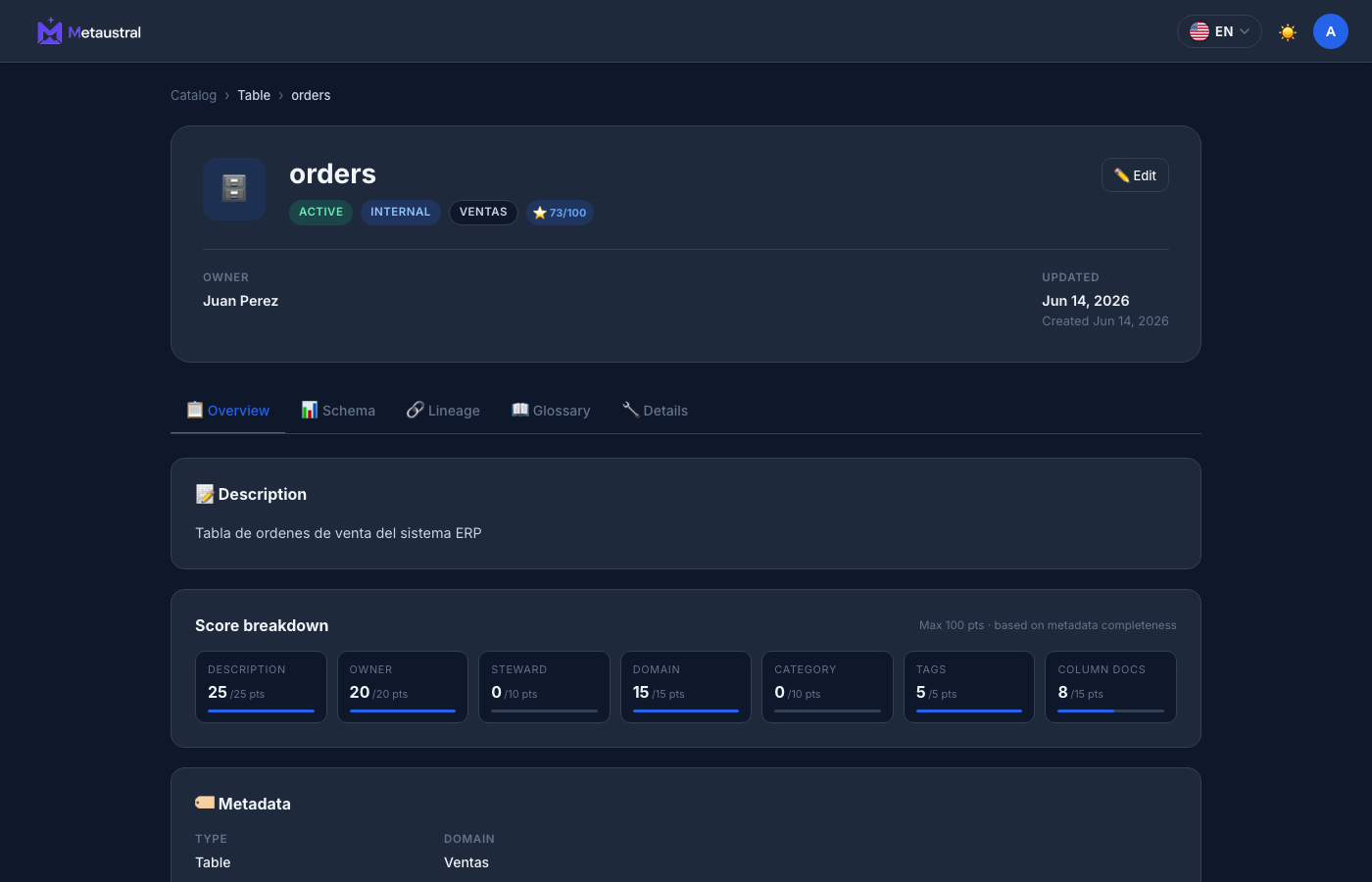
Asset detail page — metadata header with status, sensitivity, domain, quality score badge, and a breakdown of score points by field (description, owner, steward, domain, category, tags, column docs).
6.3 Asset Ownership
- Owner: the person (or team) responsible for producing and maintaining the data.
- Steward: the person responsible for ensuring metadata quality and documentation accuracy.
6.4 Tags, Domain & Classification
- Tags: free-form labels for filtering (e.g.
finance,pii). - Domain: the business area the asset belongs to (e.g. Sales, Marketing, HR).
- Category: a sub-grouping within a domain.
- Sensitivity: one of
public,internal,confidential, orrestricted.